
Depending on the culture and circumstances, a kiss can express a wide range of emotions, such as love, passion, romance, sexual attraction, sexual arousal, affection, respect, a wish for peace or good luck, as well as numerous other meanings.
There are many examples of the kiss being depicted in artwork through woodblocks, sculpture, posters, book covers, etc., but I will restrict myself to 8 paintings and one iconic photograph for the purpose of this post.
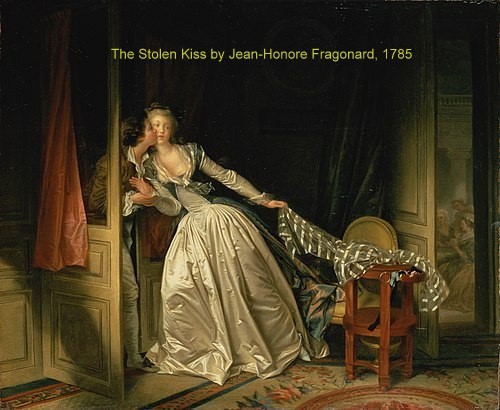
Painting from 1785 in State Museum of the Hermitage, St. Petersburg, Russia.
Jean-Honoré Fragonard (1732–1806) was a prolific French painter and a central figure of the Rococo movement, renowned for his rapid, virtuoso brushwork and lighthearted, erotic, and pastoral scenes. Born in Grasse, he trained under Francois Boucher. Fragonard was highly productive, producing over 500 paintings in his lifetime. Though his reputation waned during his later years, he is now celebrated as one of the most brilliant painters of the 18th century. He died in 1806 in relative poverty and anonymity.
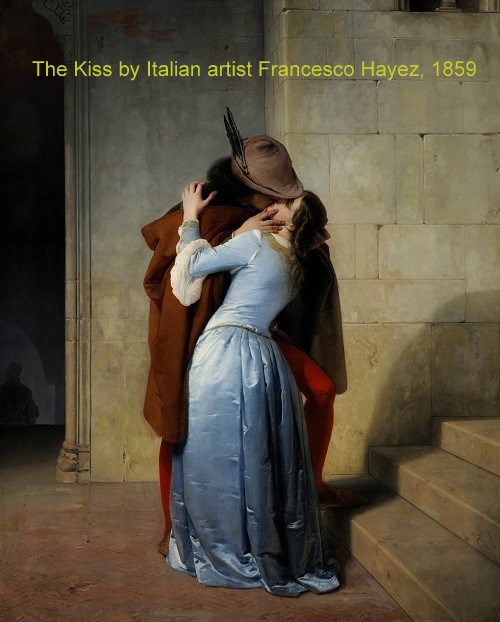
The Kiss by Francesco Hayez, 1859. It is displayed in The Pinacoteca di Brera, the main public gallery for paintings in Milan, Italy.
Born February 10, 1791, in Venice to a poor family of French-Venetian origin. Francesco Hayez (1791–1882) was the leading Italian Romantic painter in 19th-century Milan, renowned for blending Neoclassical precision with emotional, patriotic themes. His work, including the iconic The Kiss (1859), featured historical scenes, portraits, and political allegories supporting Italian unification. He served as a professor and director at the Brera Academy. He passed away in Milan, Italy.
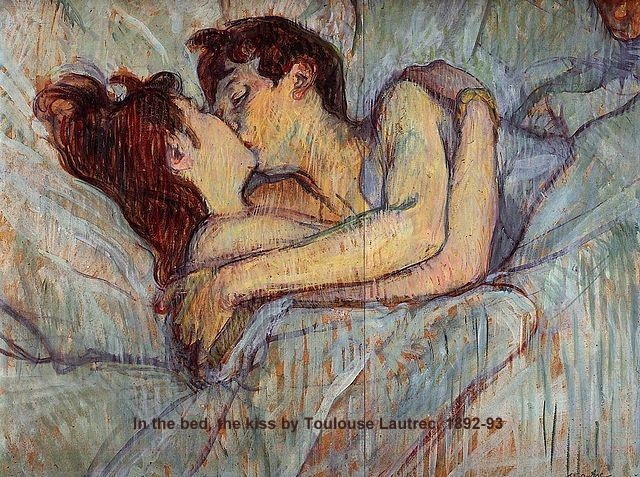
Toulouse-Lautrec – “In the bed, the kiss” (between 1892 and 1893) in a private collection.
Henri de Toulouse-Lautrec (1864 – 1901)
One of the leading Post-Impressionist painters, Toulouse-Lautrec was born at Albi (in the south of France) the son of Count Alphonse de Toulouse-Lautrec, one of the oldest and most prestigious French families,
During his brief artistic career, Henri de Toulouse-Lautrec captured the lively and often sordid atmosphere of Montmartre’s late 19th-century dance halls, cabarets, and theaters. From 1891 until his death he produced nearly 350 lithographic posters, editioned portfolios, and illustrations for journals and theater programs.
Lautrec’s alcohol consumption eventually caught up with him and in 1899, he suffered a severe nervous breakdown, spending three months in a clinic. Despite attempts at recovery, his health deteriorated, culminating in a stroke and partial paralysis. He passed away on September 9, 1901, at the age of 36, leaving behind a legacy of innovative art and enduring influence.
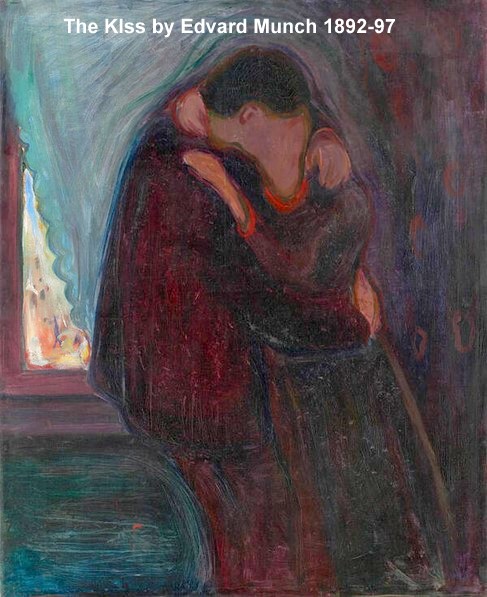
The Kiss (1892-97) by Edvard Munch is abstract and drab compared to Klimt’s painting of the Kiss (below) but still very compelling.
Edvard Munch (1863–1944) Born in a farmhouse in the village of Ådalsbruk in Løten, Norway, Munch was a Norwegian painter and printmaker whose intensely emotional, Symbolist-inspired work pioneered Expressionism. Edvard Munch was confronted with death early on. When he was six years old, his mother passed away from tuberculosis, and his sister died a few years later. The death of his father in 1901 who was prone to severe depression, plunged him into a deep crisis. In 1908 he had a mental breakdown and served seven months in a facility in Copenhagen.
Known for The Scream (1893), his art focused on themes of anxiety, love, death, and human vulnerability, deeply influenced by a childhood overshadowed by disease, bereavement, and strict religious views. Munch was incredibly prolific, creating thousands of artworks over his six-decade career. And because he enjoyed widespread fame by the end of his life, he wasn’t compelled to sell the majority of his paintings and prints, but rather retained and lived with them. His works were so powerful that they caused a sensation when he first exhibited them, but not everyone loved them. His paintings were controversial because they depicted such unsettling themes as death and insanity. He lived and worked in relative isolation at Ekely, near Oslo, continuing to paint until his death on January 23, 1944. He left the majority of his work to the City of Oslo.
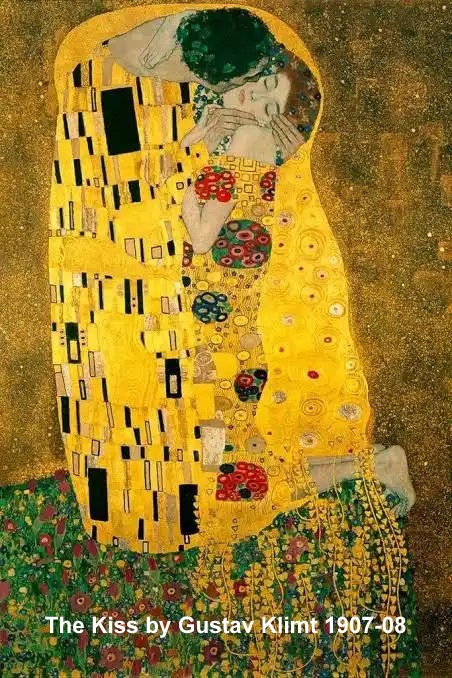
The Kiss by Gustav Klimt 1907-08
The painting now hangs in the Österreichische Galerie Belvedere museum in the Upper Belvedere Palace in Vienna, and is considered a masterpiece of Vienna Secession – the local variation of Art Nouveau – and probably Klimt’s most important work.
Gustav Klimt (1862–1918) was a pioneering Austrian Symbolist painter and a leading figure of the Vienna Secession movement. Known for his decorative style, golden leaf techniques, and erotic themes; his work combined complex psychological symbolism, mythological themes, and overt female sensuality, often causing controversy. He heavily featured female figures, eroticism, and mosaics, transforming late 19th-century art into decorative, luxurious Art Nouveau masterpieces. Though he never married, Klimt had many lovers and is said to have fathered 14 children. Klimt died in 1918 in Vienna at age 55 due to pneumonia contracted during the influenza pandemic of that year.
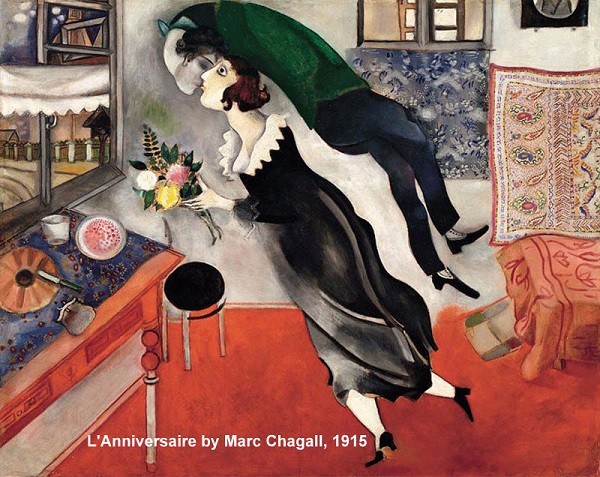
L’Anniversaire by Marc Chagall, 1915 showcased at the MOMA in New York City
Marc Chagall (1887–1985) was a Belarusian-French artist and early modernist known for his dreamlike, vibrant paintings blending Russian Jewish folklore with Fauvist and Cubist influences. His iconic style features floating figures, nostalgic memories of Vitebsk where he was born, and rich symbolism, spanning painting, stained glass, and stage design. Born Moishe Shagal on July 7, 1887, in Vitebsk, Russian Empire (now Belarus). He grew up in a poor, religious Jewish family, the eldest of nine children.
Prodigious in oil painting, stained glass, murals, ceramics, tapestries, and book illustrations. Chagall is considered a master of 20th-century art, bridging the gap between surrealism and expressionism with a unique, poetic vision. Passed away on March 28, 1985, in Saint-Paul-de-Vence, France, aged 97.
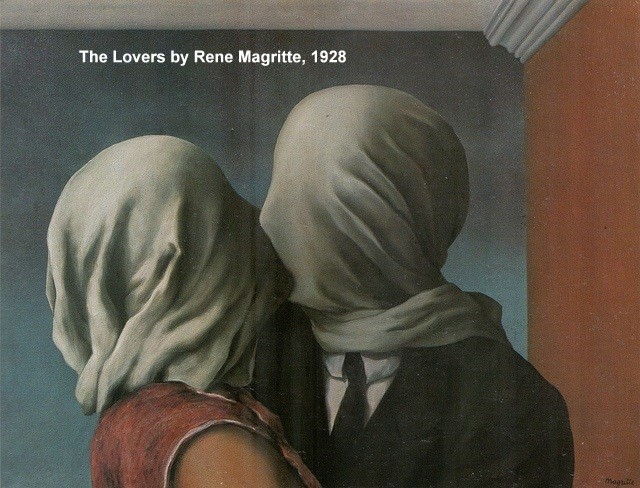
Magritte’s The Lovers (1928) – The Museum of Modern Art in NY
René Magritte (1898–1967) was a prominent Belgian Surrealist artist known for challenging perceptions of reality by placing ordinary objects—bowler hats, pipes, apples—in unusual, unsettling contexts.
He found respite from his challenging and unstable childhood — with an unpredictable textile merchant father and a mother who suffered from depression and eventually committed suicide by drowning in a river— by running rampant with his brothers, Raymond and Paul.
Magritte’s earliest oil paintings, which date from about 1915, were Impressionistic in style. From 1916 to 1918 he studied at the Academie Royale des Beaux-Arts in Brussels. The oil paintings he produced during the years 1918-1924 were influenced by Futurism and by the offshoot of Cubism practiced by Metzinger. Most of his works of this period are female nudes. Magritte explored his ideas through a variety of media, including photography, printmaking and sculpture. His gouaches, revered for their delicacy and detail, are an important part of his oeuvre.
Magritte’s successful career in advertising — he ran an agency, Studio Dongo, with his brother, Paul, in the 1930s — probably helped to hone his idea of how to make an image stick. In a tumbledown shack in his garden, Magritte created posters, music covers and advertisements right up until the 1950s, long after he had become internationally acknowledged as an artist. He never abandoned the commercial world, but went on appropriating its advertising strategies into much of his art.
Popular interest in Magritte’s work rose considerably in the 1960s, and his imagery has influenced pop, minimalist and conceptual art. Magritte died of pancreatic cancer on 15 August 1967.
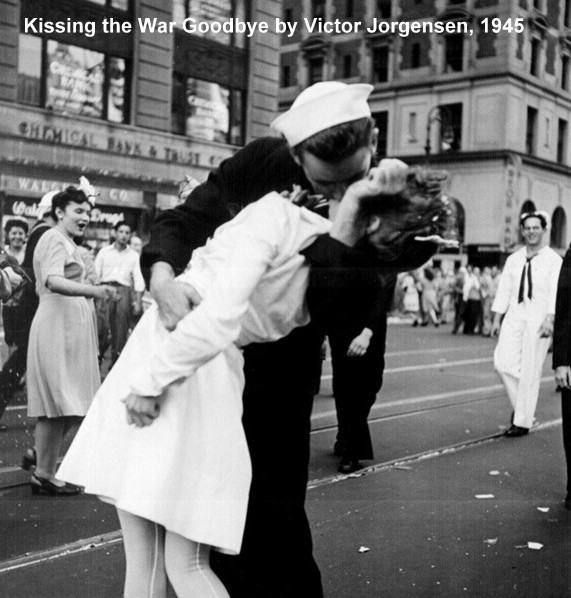
Victor Jorgensen – “Kissing the War Goodbye” (1945) – National Archives Museum in Washington, D.C.
Victor Jorgensen was born in Portland, Oregon on July 8, 1913. He attended the University of Oregon and Reed College before starting work at The Oregonian, where he rose from copy boy to night city editor. It was during that time he became interested in photography as well as writing. In 1942, Jorgensen enlisted in the Navy and was one of six initial photographers recruited by Edward Steichen to join the Naval Aviation Photographic Unit during the war; and probably is most notable for taking an instantly iconic photograph of an impromptu scene in Manhattan on August 14, 1945, but from a different angle and in a less dramatic exposure than that of a photograph taken by Alfred Eisenstaedt.
Both photographs were of the same V-J Day embrace of a woman in a white dress by a sailor. Eisenstaedt’s better known photograph, V-J Day in Times Square, was published in Life. The one taken by Jorgensen appeared in the New York Times.
Victor Jorgensen died of cancer on June 14, 1994, just before his 81st birthday.
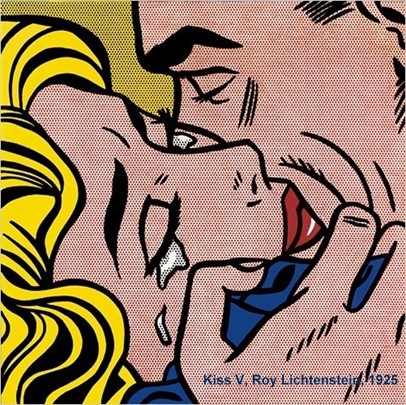
Roy Lichtenstein – “Kiss V” (1964) painting is held in a private collection
Roy Fox Lichtenstein ( LIK-tən-STYN; October 27, 1923 – September 29, 1997) was an American artist born in New York City. A leading figure of the Pop Art movement, he is best known for his large-scale paintings inspired by comic books, advertisements, and mass-produced imagery.
Lichtenstein’s work broke the barriers between popular culture and fine art, challenging long-held conventions and paving the way for new forms of artistic expression. Roy showed artistic and musical ability early on: he drew, painted and sculpted as a teenager, and spent many hours in the American Museum of Natural History and the Museum of Modern Art. He played piano and clarinet, and developed an enduring love of jazz, frequenting the nightspots in Midtown to hear it.
Early in his artistic career Lichtenstein studied the work of Pablo Picasso, Paul Klee, Wassily Kandinsky, and Joan Miró. Eventually he realized that some of the techniques employed by these artists were also used in the comics he loved, including outlines, abstracted shapes, and flattened forms.
In August 1997, Lichtenstein fell ill with pneumonia. He died unexpectedly of complications from the disease on September 29, 1997, at the age of 73.
This is a rather long post, but hope you enjoyed it.

