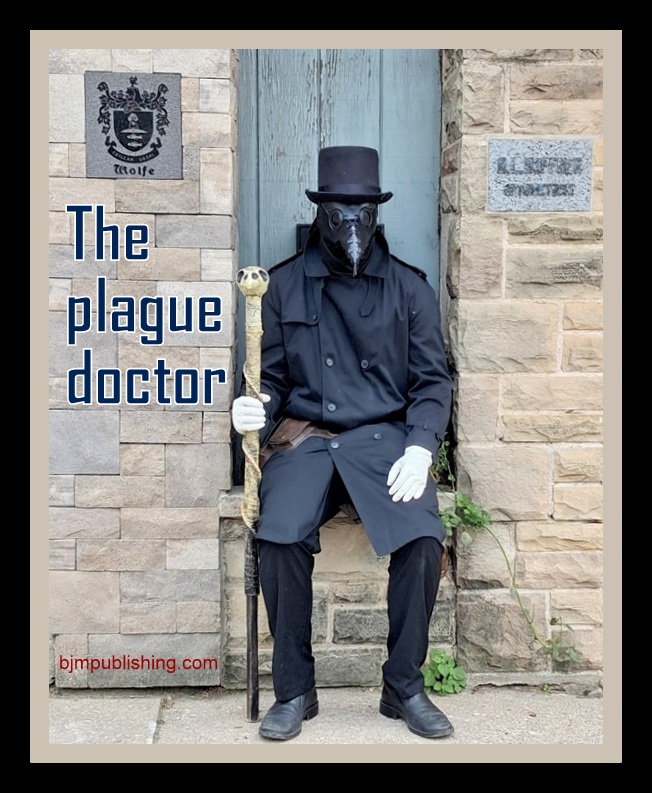
Photo above taken at the recent Cogs and Steampunk Festival in Fergus, Sept, 2026
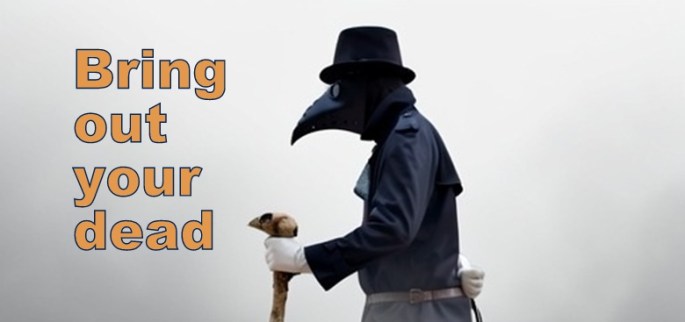
A plague doctor was a specialized municipal physician hired by towns and cities in Europe during 17th-century plague epidemics to treat victims, especially the poor who could not pay. These physicians wore this unsettling outfit to protect themselves from the plague. It was an early version of the present-day personal protective equipment (PPE).
What They Meant and Symbolized
Harbingers of Death: Because they usually arrived only when an outbreak began and rarely cured anyone, seeing a plague doctor meant that severe illness or death was nearby.
Public Record Keepers: Beyond medical care, their role meant documenting the dead, counting infection numbers, witnessing wills, and performing autopsies for demographic and civic data.
A Symbol of Fear: Over time, the terrifying medical uniform transformed into a popular Carnival of Venice character, symbolizing mystery, history, and a memento mori (a reminder of mortality).
The Iconic Costume
The Beaked Mask: The mask featured a long bird-like beak stuffed with strong herbs, spices, and camphor. People believed disease spread through “miasma” (poisonous “bad air”), and the herbs were meant to filter or purify it.
Protective Suit: They wore a head-to-toe heavy waxed leather or canvas robe, boots, and gloves. While designed to block bad air, it accidentally offered minor protection against bodily fluids and flea bites. The hat was worn to make people aware that they were physicians. The cloak and gloves were worn to prevent skin-on-skin contact with patients.
The Wooden Wand: Doctors carried a cane or stick to examine and point at patients without having to touch them.
I would imagine that seeing this frightening figure morph out of a misty morning fog, even if you were near death; you’d jump up and run for cover.
Prince Edward Island (PEI) has two distinct lobster fishing seasons: a spring season from late April/early May to late June; this is the largest harvest, accounting for about 75% of the catch, and a fall season from mid-August to mid-October. PEI splits its lobster fishing into two distinct regional seasons to protect the lobsters during vulnerable biological cycles like molting and mating.
The lobster fishery brings in tens of millions of pounds of catch annually, accounting for about 15% of Canada’s total lobster production. It provides vital jobs for over 1,200 licensed fishers and supports processing plants, local harbors, and tourism.
Nova Scotia catches the most lobsters of any province in Canada, accounting for roughly 45% to 50% of the country’s total annual catch. Additionally, the town of Shediac, New Brunswick, is widely known and promoted as the “Lobster Capital of the World” due to its rich fishing heritage and famous 90-tonne giant lobster monument.
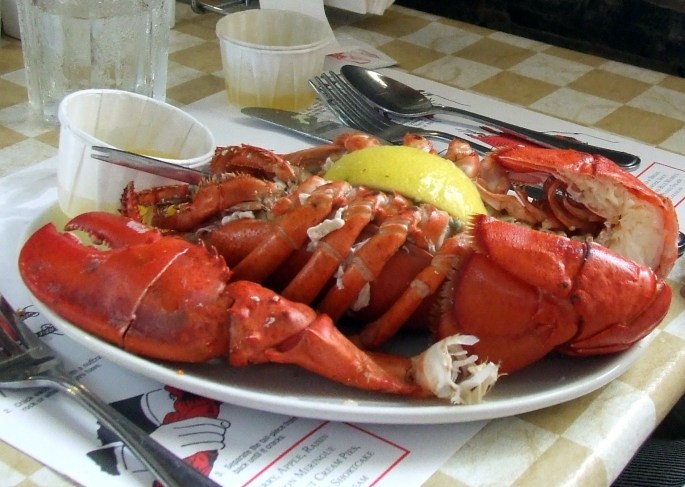
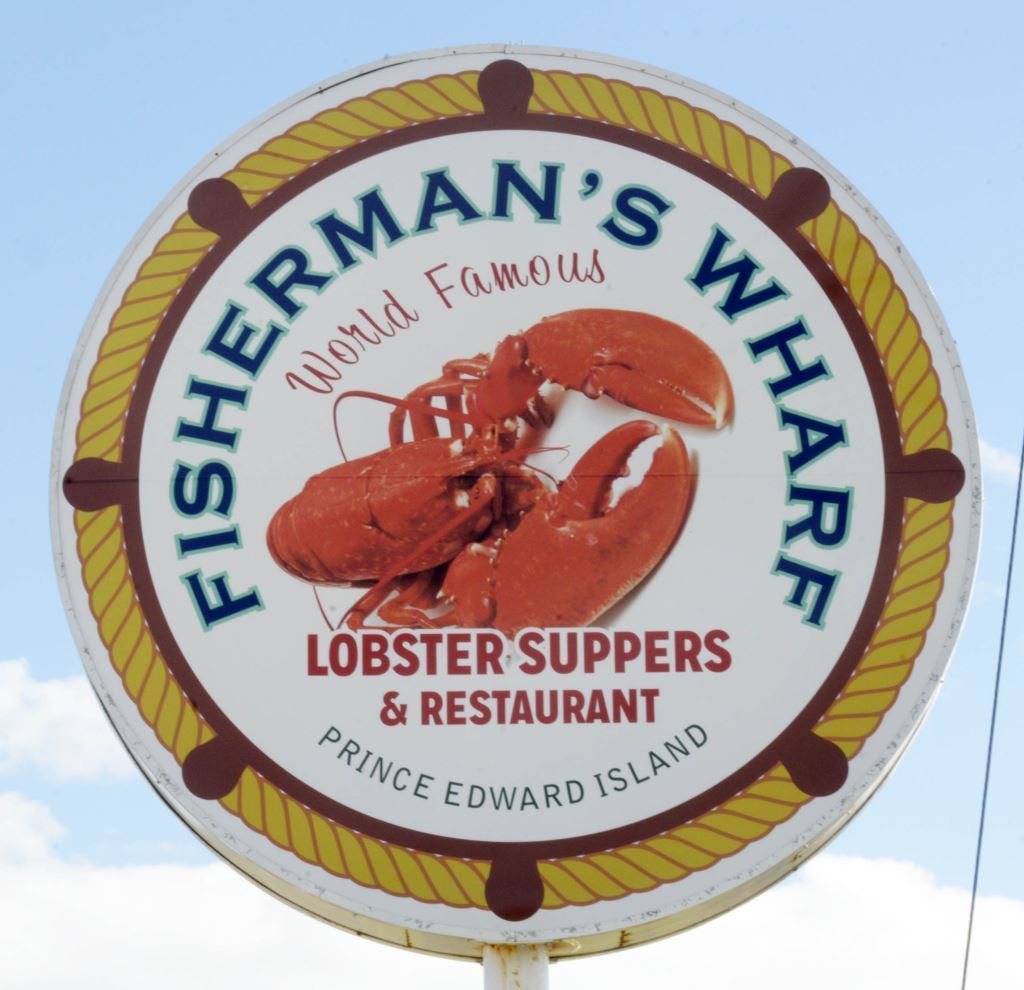
For a traditional lobster supper there are three main places to partake of succulent, mouth-watering lobster and though it may appear expensive when you think about how everything is included with the meal and the price of appetizers and desserts now, it isn’t that bad. A special occasion for sure.
Lobster supper
Supper Location
Estimated Price Range
Key Feature / Unlimited Sides
Atmosphere
New Glasgow
CAD 40–60
a short drive from the city, serving a complete multi-course lobster meal with unlimited sides of mussels, chowder, and pie.
Historic community hall
Fisherman’s Wharf
CAD 40–80
60-foot salad and dessert bar & endless mussels.
Expansive & nautical
Lobster on the Wharf
CAD 30–80
À la carte platters & fresh pound
Scenic harbor deck
You are not limited to lobster suppers, you can go down to the local pier in most towns and get live lobster to take home or cook up, and there are plenty of places to grab a lobster roll. Some of the best places on Prince Edward Island include acclaimed spots like Richard’s Fresh Seafood in Covehead and Victoria-by-the-Sea, Blue Mussel Cafe in North Rustico, the Water Prince Corner Shop in Charlottetown, the Seafood Shack, and Point Prim Chowder House and Oyster Bar. I’m sure I have left some out but that’s what exploring on vacation is all about.
It’s a wild world out there, and frankly, the “bullshit meter” has to work harder than ever.
Bullshit often relies on outrage or extreme validation. If an article makes you feel immediately furious or smugly “right,” it’s likely designed to bypass your logic. The Test: Ask, “Is this trying to inform me, or is it trying to make me feel something?”
Don’t just look at the website name—look at the URL and the “About Us” section. URLs that mimic real news sites (e.g., .co instead of .com) or sites that lack a clear masthead or editorial policy are a red flag. Don’t just read the site itself. Open a new tab and search for the site’s name. What do other reputable sources say about their credibility?
Quality writing links to primary sources (original studies, official transcripts, or direct data). A post that says “Scientists say…” without naming the scientists or linking to the actual study is likely bullshit. Click the links. Sometimes, a “source” is just another blog post from the same author, creating a circular loop of nothingness.
Search for the topic on a site known to have the opposite bias of what you’re currently reading. If the “facts” differ wildly, the truth is usually buried somewhere in the middle.
If you see a “breaking news” photo that looks too perfect, right-click and “Search Image with Google.” You might find that the “current” photo is actually from a protest in 2014 or a movie set.
A liar knows the truth and tries to hide it; a bullshitter doesn’t care what the truth is—they just want to get a reaction.
“An idiom is a phrase or expression whose meaning cannot be understood from the literal definition of its individual words. It is a figurative saying peculiar to a specific culture or language, where the group of words has a generally understood meaning different from the literal interpretation“
Body Parts
Cold feet: Being nervous or reconsidering a decision. Its modern usage meaning “lack of courage” appeared in American fiction in the late 19th century. One theory suggests it comes from gamblers who would claim to have “cold feet” as an excuse to leave a poker game before they lost any more money. An older Italian “Lombard proverb” also linked cold feet to being out of money.
Pulling someone’s leg: Joking with someone or teasing them.
Pulling the wool over someone’s eyes: means to intentionally deceive, trick, or mislead someone to prevent them from discovering the truth. It implies manipulating someone by hiding facts, often for personal gain. It is an informal idiom often used to describe someone being foolish or tricked
A chip on your shoulder: Holding a grudge or being easily angered.
Get off my back: Stop bothering or pressuring someone.
Bite off more than you can chew: Taking on a task that is too difficult. This idiom emerged in 19th-century America and refers to the practice of chewing tobacco. People would offer others a “plug” of tobacco, and greedy individuals might take a bite so large they couldn’t handle it comfortably or would even get sick.
Break a leg: A way to wish someone “good luck,” usually before a performance. This theatrical well-wishing began in the 1920s. Because theater folk are notoriously superstitious and believe wishing “good luck” actually causes bad luck, they wish for the opposite. Some suggest it refers to “breaking the leg line” (entering the stage past the side curtains, known as “legs”) or bending the knee in a deep bow after a successful show.
Cost an arm and a leg: Something that is excessively expensive.
Living hand to mouth: Having only enough money to satisfy immediate needs without any savings.
In over my head: to be involved in a difficult situation that you cannot get out of
By the skin of your teeth: To barely succeed at something or to narrowly avoid disaster.
Don’t throw the baby out with the bathwater: is an idiom advising against losing valuable things while trying to eliminate unwanted ones. It means avoiding overreactions that discard good aspects along with the bad. Common examples include quitting a job over one minor issue or scrapping a whole project due to small errors
Animals
When pigs fly: Something that is impossible or will never happen.
Bring home the bacon: To earn a living or provide financial support for a family. Its origin likely stems from 16th-century country fairs where people competed to catch a greased pig; the winner literally “brought home the bacon”.
Raining cats and dogs: Raining very heavily. While there are many theories, one of the most common involves 17th-century street drainage. During heavy storms, debris and unfortunately drowned animals would be washed through the streets, making it look as though they had fallen with the rain.
Like a blue-arsed fly: Running around frantically or being very busy (common in UK/Australia).
Like a chicken with its head cut off: Acting in a frantic, disorganized, or senseless manner. Similar to above.
The elephant in the room: A major problem or controversial issue that is present but everyone is ignoring.
Let the cat out of the bag: To accidentally or prematurely reveal a secret. This phrase likely traces back to a medieval market scam. Merchants would sell what they claimed were valuable piglets in sacks (known as a “poke” – buying a pig in a poke). If the buyer was suspicious and opened the bag, they might find a worthless stray cat instead—thus “letting the cat out of the bag” and revealing the secret.
A man on a galloping horse wouldn’t notice: Used when a small mistake is insignificant and won’t be seen by someone passing by quickly.
Get off your high horse: It is used to tell someone to stop judging others or behaving as if they are better or more important. The phrase originated from medieval times when high-ranking people rode very large horses.
Miscellaneous
Hit the nail on the head: To describe exactly what is causing a situation or to be precisely correct. This phrase has been around for centuries, appearing as early as the 15th century. It is a simple metaphor for accuracy and skill—a carpenter who hits a nail perfectly on its head is doing the job exactly right
Piece of cake: Something that is very easy to do.
Break the bank: To be extremely expensive or to spend all of one’s money on a single purchase.
Born with a silver spoon in your mouth: Born into a wealthy and privileged family.
In the red / In the black: These terms come from traditional bookkeeping, where accountants used red ink to show losses (debt) and black ink to show profits.
Time is money: An expression used to emphasize that time is a valuable resource and should not be wasted.
and on that note, I think I will call it a day: to stop working or end an activity for the time being……
The man I’m about to tell you about was a giant—though he stood shorter than most.
His name was Greg Clark. Before the world got loud and digital, Greg was the voice of Canada. Back in the day, he was more famous than the Prime Minister, and for good reason. The editorial director of Weekend Magazine, once described Clark as “a man so Canadian that no other land could possibly have produced him.”
He started out as a bit of a rebel—failed out of the University of Toronto twice—before landing at the Toronto Star in 1911 where his old man was an editor. But the real world came calling in 1916. Greg went over to the mud and blood of the Great War. He survived three years in the trenches, winning the Military Cross for bravery at Vimy Ridge.
When he came home a Major, he wrote a story that still haunts the neighbourhood in Toronto. It’s called “One Block of Howland Avenue.” You see, every single young man on his block died in that war, except for Greg and his brother. When they finally came home from the war their father met them at the beginning of the street and begged them to take the long way around—to go through the back alleys—so the grieving neighbours wouldn’t have to see two sons coming home when theirs never would.
Greg carried that heart into his writing. In the ’20s, he sat across from a “tall young squirt” named Ernest Hemingway at the Toronto Star. Greg actually told the kid to give up on fiction and stick to reporting! He laughed about that later, of course, once Hemingway became… well, Hemingway.
Through the 30’s, Greg was the man people turned to. He covered the big stuff—the Lindbergh trial, the forming of the UN, the coronation of a King—but his greatest moment was at the Moose River Mine. When every other reporter packed up and gave up on the trapped miners, Greg stayed. He was there, in the silence of the woods, when the first faint tap-tap-tap came from the earth. He got the scoop because he had the patience to wait.
Though he was too old to fight in the second war, he went back as a correspondent. He saw the Blitz, Dunkirk, and the front lines in Italy. He lost his own son to that war, a blow that would’ve broken a lesser man. But Greg kept writing. He moved to the Montreal Standard and Weekend Magazine, sharing tales in his column, “The Packsack,” that felt like a warm letter from an old friend.
He won everything—the Order of Canada, the Leacock Medal, honorary doctorates. But if you asked him? He’d probably tell you his proudest moment was being inducted into the Canadian Fishing Hall of Fame.
He died in ’77, and most of his nineteen books have slipped out of print, which is a damn shame. He knew how to find the “human touch” in the darkest of times. He lived through the horrors of war and the heartbreak of losing his son and wife, yet he still wrote with a rhythm and a grace that made you feel like the world was going to be alright.
So, next time you’re in a dusty old bookstore, look for his name. Scour the shelves for a bit of Greg Clark. We could all use a little more of his integrity and his humour in our own lives today.
When adventure calls
I have been lucky enough to have travelled to some of the most beautiful places on earth but there are still many places I'd like to see.