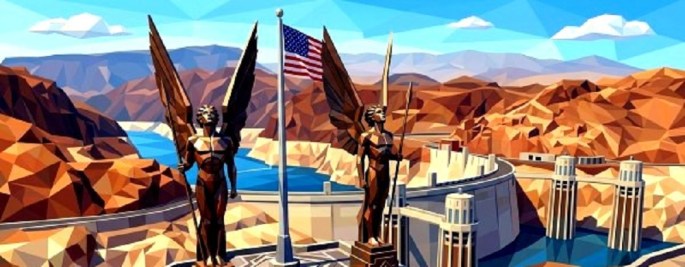
Imagine we are stepping into the dirty 1930s—a time when the American nation was brought to its knees by the Great Depression, yet somehow we reached for the sky to accomplish the impossible. Imagine standing at the edge of the Black Canyon in 1931 which straddles the borders of Nevada and Arizona. Below you, the wild Colorado River rages—an untamed beast fed by the distant, melting snows of the Rocky Mountains. For decades, it had been a force of devastation, unleashing relentless floods that swallowed nearby farms, wiped out settlements, and threatened the fragile dream of expanding the American West.
The nation needed a solution, and thousands of desperate workers needed a lifeline. Enter the United States Department of the Interior’s Bureau of Reclamation, supported by a coalition of two hundred visionary engineers tasked with designing a structure so immense it defied belief.
Over five grueling years, thousands of men descended upon the desert heat to carve through solid rock, plunging more than 500 feet into the canyon walls. They carved out miles of subterranean tunnels and laid massive 30-foot-wide steel pipes known as penstocks. Together, they poured a mind-boggling 3.125 million cubic yards of concrete—creating a monolithic arch-gravity wall that weighs more than 6.6 million tons and rises to an astonishing 726.4 feet.
Against all odds, the workers finished the dam, its power plant, and its striking Art Deco architectural details in 1936—a full two years ahead of schedule.
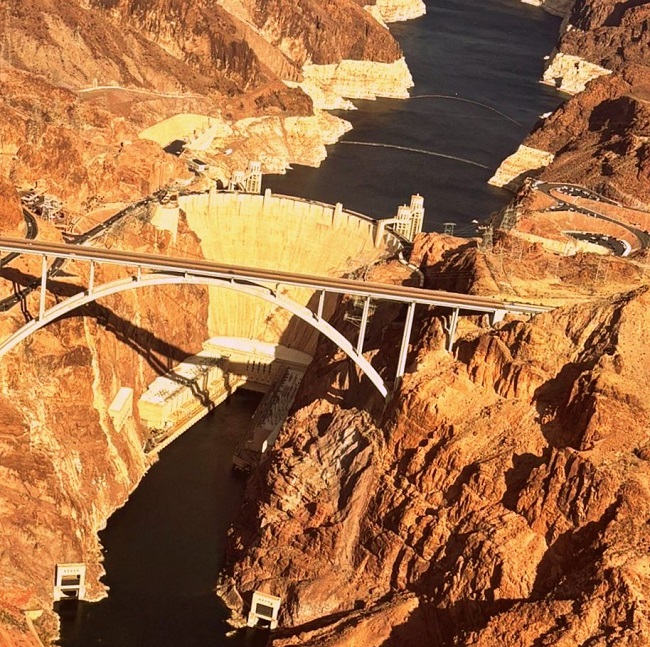
Initially called the Boulder Dam before being renamed the “Hoover Dam”, this structure didn’t just tame the river—it redefined the Southwest. It birthed Lake Mead, the largest man-made reservoir in the United States, plunging to depths of 532 feet at full capacity and holding enough water to submerge the entire state of Pennsylvania a foot deep. It provided life-giving irrigation to arid desert fields, provided steady jobs when the country needed them most, and fired up massive hydroelectric generators that sent clean, roaring electricity straight to the burgeoning neon lights of Las Vegas and the sprawling neighborhoods of Los Angeles. It was, quite rightfully, crowned by the American Society of Civil Engineers as one of America’s Seven Modern Civil Engineering Wonders.
Today, if you visit, you can walk for free along its 1,244-foot crest, looking down at a structure engineered so masterfully that its concrete physical body is estimated to endure for thousands—if not tens of thousands—of years. However… here is the tragic twist in our historical narrative.
While the concrete titan itself may stand virtually forever, its functional heart is racing against time. Lake Mead is shrinking. When regional leaders signed the 1922 Colorado River Compact, they made a critical error: they promised more water to surrounding states than the river actually possessed. Today, that mathematical miscalculation has caught up with us. Driven by long-term drought, hotter temperatures evaporating the reservoir’s surface, dwindling snowpack in the Rockies, and the relentless demand of millions of people and farms, more water is being pulled out than the river can replenish.
The Hoover Dam stands as a monumental testament to what human ingenuity can conquer when pushed to the brink. But as we look at its receding waterlines today, it presents us with a profound question for the 21st century: We proved we could tame the wild river—but can we learn to live within its limits?